
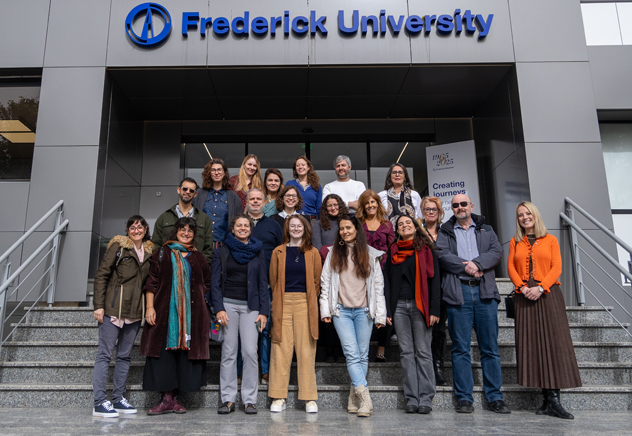
Partners of the SWELL project met at Frederick University to officially kick off the project


SWELL is an European Erasmus+ project that aims to enhance the wellbeing of educators and learners through innovative, democratic, and participatory learning practices.
The SWELL project, an acronym for Self-directed Learning for the Wellbeing of Educators and Lifelong Learners, focuses on self-directed learning (SDL) as a powerful approach to fostering autonomy, professional growth, and sustainable learning environments.
Through research, collaboration, and pilot implementations across diverse European educational contexts, SWELL explores how educators and student teachers experience learning and how autonomy, participation, and learner voice are connected to professional wellbeing. The project brings together universities, schools, training organisations, and educational networks to co-create knowledge and practical solutions grounded in real educational practice.
SWELL will develop a competence framework, training programmes, open educational resources, online courses, and the SWELL Academy, offering educators and lifelong learners accessible tools to support self-directed learning and wellbeing. A strong emphasis is placed on community building, reflective practice, and peer learning through communities of practice.
By promoting inclusive, learner-centred, and values-driven approaches to education, SWELL seeks to contribute to more sustainable and human-centred educational systems, empowering educators as active co-creators of learning, wellbeing, and educational change.
Frederick University is the project Coordinator. Partners are: the University of Limerick in Ireland, the University of MONS in Belgium, the New Bulgarian University in Bulgaria, the University of Bucharest in Romania, the Centro De Formação Calvet De Magalhães in Portugal, the Europass Teacher Academy - an Accredited National Vocational Training Organisation based in Italy, the Agrupamento de Escolas Manuel da Maia in Portugal, the Montessori British in Spain, the QUEST - a European Educational Network that promotes children’s rights in education in Europe, and EUDEC - a German-based European Democratic Education Community, an informal network of more than 200 democratic schools in Europe.
Associated partners will further complement the project impact. Among these partners are:
- the Cyprus Ministry of Education, Sport and Youth which will support the policy level of the SWELL project, and the possibility of structural adaptation of the project outcomes,
- the Agios Antonios Kindergarten in Limassol which will propose the Academy to its teachers,
- the Forest School Tree-gether which will work in cooperation with Frederick University to ensure a practical ground where the Academy practices will be tested, and
- the Pedagogical Institute of Cyprus which will support the scientific development of the curriculum and its application in Cyprus.
 View all articles