
 Search




Art and artistry in designing the built environment
The Department of Architecture prepares future architects by equipping them with a deep understanding of the built environment, specifically within Εurope and the Mediterranean. Its mission is to create a distinctive educational environment that sets itself apart through unique academic and strategic choices, particularly in teaching and learning practices, while fostering a robust body of research within the broader field of architecture.
Aiming to equip students with the necessary tools to design the built environment with both knowledge and sensitivity, the Department focuses on creating work that protects the environment and architectural heritage, addresses seismic risks, and ensures buildings meet high bioclimatic standards.
The Department includes the Urban Planning and Development Unit, which focuses on research in urban planning, sustainability, and urban development. The faculty is actively participating in European programs such as LIFECALLIOPI, which promotes sustainable coastal design, EUMAP, which addresses crises in urban centers, and Urban Periscope, which focuses on energy-efficient design for important buildings.
The Department is renowned for its dedication to documenting and preserving architectural heritage, through the work of the Research Unit for Historical Constructional Systems. The Department has extensively studied the restoration of numerous historical buildings in Cyprus and Greece, including UNESCO-protected Byzantine churches in the Troodos region, ancient bridges recognized as monuments, and Venetian structures in the old city of Nicosia. Through relevant research programs, students have the opportunity to explore these sites across Cyprus and Greece, contributing to the restoration of buildings with centuries-old histories.
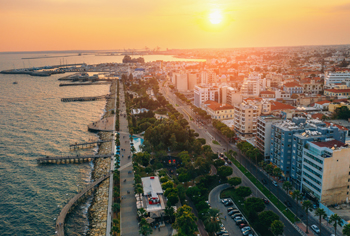
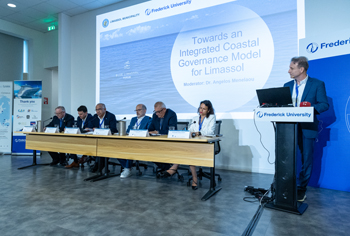
In collaboration with other Departments at Frederick University, the Department of Architecture serves as scientific advisor for the “Coastal and Port” thematic area of the EU Mission: Climate Neutral and Smart Cities. This is one of six thematic areas included in Limassol’s Action Plan to become climate neutral in an inclusive and sustainable way, by 2030.
Within the Department’s programs of study, students are given the opportunity to create projects that make a lasting impact. They gain hands-on experience by working on projects in collaboration with companies, organizations and public authorities, within the Frederick University Living Lab – FULL pedagogical initiative.

High employability
80% of our graduates are employed in architectural firms, while 15% hold managerial or partnership positions in design offices

Sustainable Thinking
Commitment to architectural practices that serve society and the environment.

Research
Contributing to the sustainable development of cities through research

Expert Faculty
Ιntegration of the sustainable development goals into teaching
The program is dedicated to create qualified graduates with ethical values, able to pursue academic and professional careers in the field of Civil Engineering. The program has two directions, the general Civil Engineering direction, and the Quantity Surveying direction. The program aims in the developing of graduates with a diverse set of skills that can solve complex problems, work and communicate efficiently and effectively in teams and develop basic leadership competencies that allows them to lead design or construction management teams in their carrier as professional Civil Engineers. Furthermore, the program provides a strong foundation for students to pursue graduate studies.
The main objectives of the program are to:
- provide students with a spherical knowledge of the field of civil engineering that includes all disciplines of the profession,
- educate students to be competent in the analysis and design of structures, evaluation and selection of appropriate materials, management of construction sites and personnel, identification of environmental impacts related to civil engineering projects and proposition of mitigation measures or actions, promote sustainable construction and development and
- identify ethical responsibilities of practicing engineers,
- help students develop the skills needed to ensure a successful career in the field of civil engineering,
- prepare students for direct employment after graduation by integrating theory with practice, through activities like industrial placement and capstone analysis and design projects.
- prepare students for graduate studies by helping them acquire the required knowledge and develop the necessary skills.
The language of the program is English.
1. Apply the knowledge of mathematics, physics and engineering fundamentals to the solution of engineering problems;
2. Develop critical thinking, individual and teamwork skills to solve engineering problems with realistic constraints;
3. Handle open ended design problems apply general principles of the legislative framework, relating to civil engineering problems including multiple alternatives;
4. Engage in innovative projects that incorporate real life scenarios, promote sustainability and constructability and raise the awareness for team work in multidisciplinary setting;
5. Solve complex engineering problems considering public health and safety, cultural, societal, and environmental issues;
6. Utilize the current state of the art and research methods to design and execute experimental and numerical investigations, analyze and interpret data to provide valid conclusions;
7. Acquire the expertise to carry out computer-assisted analysis of engineering problems and evaluate the validity of software output;
8. Participation in professional societies and organizations, understand and appreciate the societal context of the civil engineering profession, and the ethical responsibilities of practicing engineers;
9. Communicate and defend complex ideas effectively, including oral, written, and technical report writing skills;
10. Manage construction operations and maintenance activities implementing basic concepts of engineering economics and feasibility studies;
11. Promote the engagement in life-long learning in the broadest context of technological change.
The programme will also provide valuable background expertise for those wishing to enter into asset management or to begin to pursue a career in research and development.
The graduates of the program are eligible to register to the Technical Chamber of Cyprus (ETEK).
There are no specific admission requirements for this Program. Candidates can be admitted to the Program only if they satisfy the general admission requirements of the University.
Recognition of Prior Learning
There are no specific arrangements for recognition of prior learning for this Program. Candidates can be granted transfer credits according to the general arrangements for recognition of prior learning of the University.
There are no specific examination regulations, assessment and grading methods employed by this Program. The examination regulations, assessment methods and grading system for this Program are the same as the relevant general university regulations.
Graduation Requirements
Students are eligible for graduation after successfully completing 240 ECTS credits in the courses listed in the Program Structure.
Furthermore, a student can graduate only if their CGPA is greater or equal to 5.00 out of 10.00. Graduating students with a CGPA less than 5.00 might have to take extra courses or repeat a number of courses in order to improve their grades.
Access to Further Studies
The graduates of the Program have access to graduate studies (2nd and 3rd Cycle) in disciplines related with the discipline of Civil Engineering, including Environmental Engineering.
Explore Our Department



Diploma - Integrated Master in Architectural Engineering
The Diploma - Integrated Master in Architectural Engineering is designed to equip students with the comprehensive education required, along with specialization in architectural composition, urban and spatial planning, with a focus on architectural technology. Students will use both digital and traditional tools in design studios, helping you develop original compositions that are both aesthetically refined and practically applicable.
The program is fully accredited by the Scientific and Technical Chamber of Cyprus (ETEK) and the Technical Chamber of Greece (TEE), and graduates are eligible for registration with both Chambers.
It is also recognized by the European Commission under the relevant European directive.
MSc in Conservation and Restoration of Historical Structures
and Monuments
The aim of the program is to fully instruct students not only in the theories of the deontology and methodology concerning the protection and restoration of historical buildings, but also in the practices regarding materials and technologies, which are nowadays internationally applied in restoration projects.
The program also aims to provide further technical knowledge in the area of conservation and restoration of historical structures and monuments and it is intended to provide the educational platform to encourage the development of competent, confident and inquisitive postgraduates who are able to link restoration and conservation theory with practice.
The MSc in Conservation and Restoration of Historical Structures and Monuments is also offered via distance learning.
PhD in Architecture
The PhD program in Architecture aims to develop and disseminate new knowledge with a focus on the research fields of Conservation and Restoration of Monuments and Historical Constructions and of Environmental and Sustainable Design. It may also concern other fields of Architecture.


