Search




A legacy of innovation
The Department of Mechanical Engineering at Frederick University builds upon the strong foundations of more than 30 years of experience and tradition in higher education in the field of Mechanical Engineering.
The Department offers exceptional teaching methods and fosters an engaging environment that promotes active learning at both undergraduate and postgraduate levels. It is at the forefront of cutting-edge engineering research, having established a strong research reputation nationally, across Europe, and internationally. Additionally, the Department has forged valuable partnerships with the industry.
The programs of study are carefully designed to meet the scientific and professional needs of today’s mechanical and automotive engineers.
The Department is engaged in innovative research, dedicated to exploring sustainable solutions and pioneering advancements that drive both scientific progress and practical applications in modern engineering. With a strong focus on renewable energy technologies, its research spans a wide range of cutting-edge fields, from mechanics in nuclear medicine and advanced energy systems to additive manufacturing and road safety and road accident reconstruction with the aid of computational tools.

Links with the industry
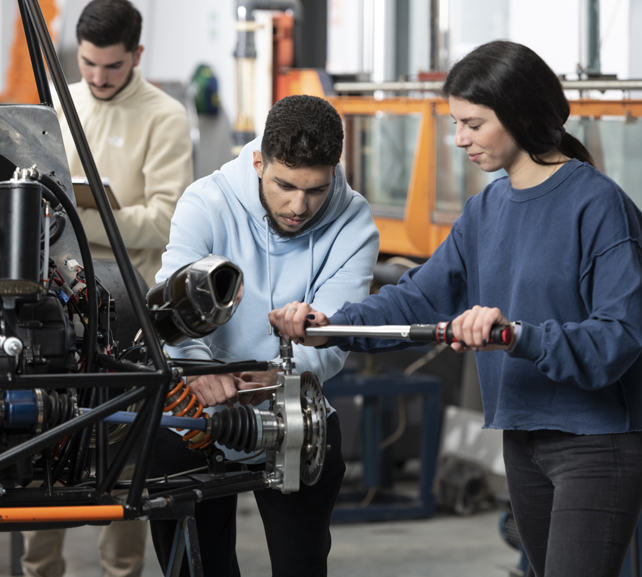
Opportunities to gain valuable practical experience, work on real projects, and connect with potential future employers

Facilities
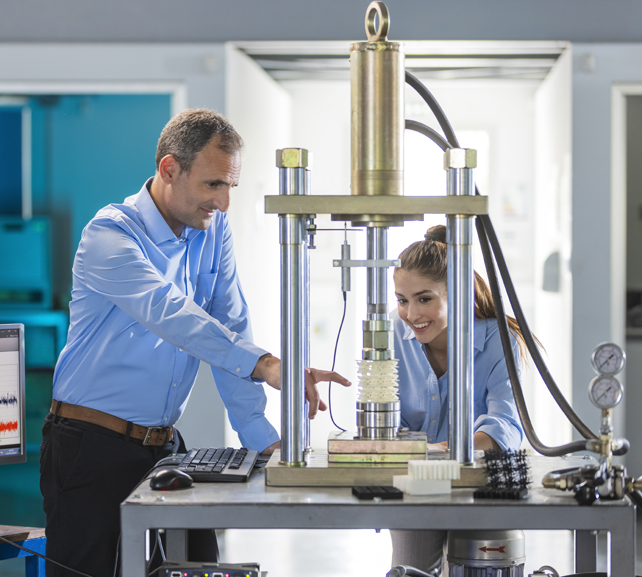
State-of-the-art research and teaching laboratories

Expert Faculty
Esteemed academics in all areas of Mechanical Engineering: from energy to aerospace, and from construction to nuclear medicine

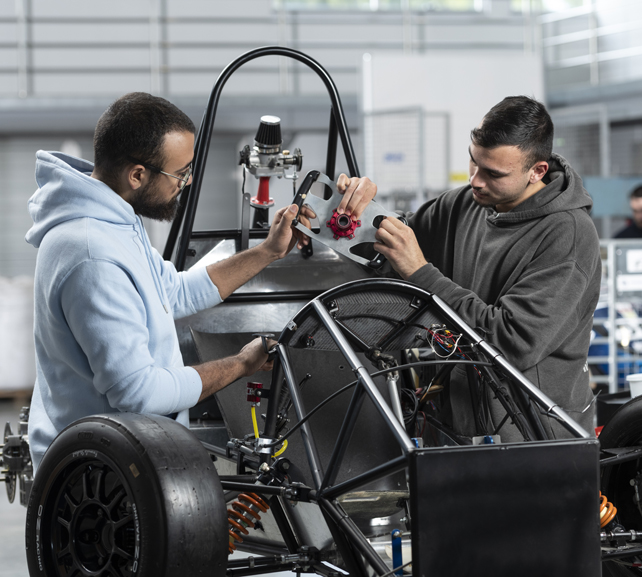
Building a formula-type car
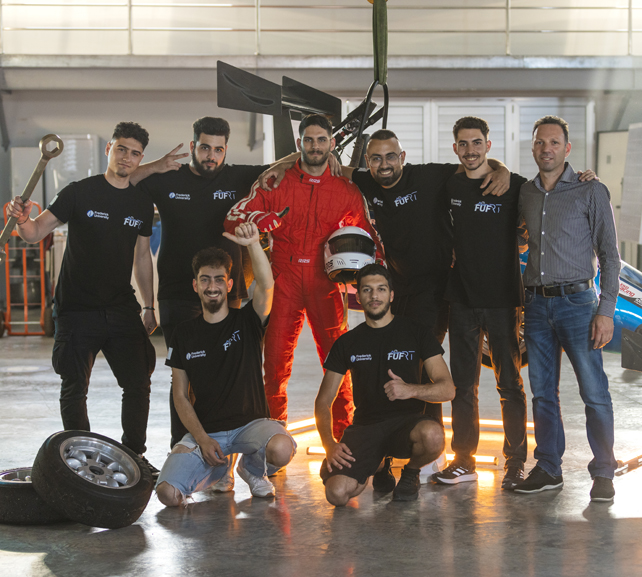
Students comprise the FUF Racing Team, the first university team in Cyprus to develop a single-seated Formula type racing car

Internship
Practical experience in the industry through a 4-month internship in a relevant company.

Research
Diverse research work in advancing renewable energy, sustainable development and many other fields
The program is dedicated to create qualified graduates with ethical values, able to pursue academic and professional careers in the field of Civil Engineering. The program has two directions, the general Civil Engineering direction, and the Quantity Surveying direction. The program aims in the developing of graduates with a diverse set of skills that can solve complex problems, work and communicate efficiently and effectively in teams and develop basic leadership competencies that allows them to lead design or construction management teams in their carrier as professional Civil Engineers. Furthermore, the program provides a strong foundation for students to pursue graduate studies.
The main objectives of the program are to:
- provide students with a spherical knowledge of the field of civil engineering that includes all disciplines of the profession,
- educate students to be competent in the analysis and design of structures, evaluation and selection of appropriate materials, management of construction sites and personnel, identification of environmental impacts related to civil engineering projects and proposition of mitigation measures or actions, promote sustainable construction and development and
- identify ethical responsibilities of practicing engineers,
- help students develop the skills needed to ensure a successful career in the field of civil engineering,
- prepare students for direct employment after graduation by integrating theory with practice, through activities like industrial placement and capstone analysis and design projects.
- prepare students for graduate studies by helping them acquire the required knowledge and develop the necessary skills.
The language of the program is English.
1. Apply the knowledge of mathematics, physics and engineering fundamentals to the solution of engineering problems;
2. Develop critical thinking, individual and teamwork skills to solve engineering problems with realistic constraints;
3. Handle open ended design problems apply general principles of the legislative framework, relating to civil engineering problems including multiple alternatives;
4. Engage in innovative projects that incorporate real life scenarios, promote sustainability and constructability and raise the awareness for team work in multidisciplinary setting;
5. Solve complex engineering problems considering public health and safety, cultural, societal, and environmental issues;
6. Utilize the current state of the art and research methods to design and execute experimental and numerical investigations, analyze and interpret data to provide valid conclusions;
7. Acquire the expertise to carry out computer-assisted analysis of engineering problems and evaluate the validity of software output;
8. Participation in professional societies and organizations, understand and appreciate the societal context of the civil engineering profession, and the ethical responsibilities of practicing engineers;
9. Communicate and defend complex ideas effectively, including oral, written, and technical report writing skills;
10. Manage construction operations and maintenance activities implementing basic concepts of engineering economics and feasibility studies;
11. Promote the engagement in life-long learning in the broadest context of technological change.
The programme will also provide valuable background expertise for those wishing to enter into asset management or to begin to pursue a career in research and development.
The graduates of the program are eligible to register to the Technical Chamber of Cyprus (ETEK).
There are no specific admission requirements for this Program. Candidates can be admitted to the Program only if they satisfy the general admission requirements of the University.
Recognition of Prior Learning
There are no specific arrangements for recognition of prior learning for this Program. Candidates can be granted transfer credits according to the general arrangements for recognition of prior learning of the University.
There are no specific examination regulations, assessment and grading methods employed by this Program. The examination regulations, assessment methods and grading system for this Program are the same as the relevant general university regulations.
Graduation Requirements
Students are eligible for graduation after successfully completing 240 ECTS credits in the courses listed in the Program Structure.
Furthermore, a student can graduate only if their CGPA is greater or equal to 5.00 out of 10.00. Graduating students with a CGPA less than 5.00 might have to take extra courses or repeat a number of courses in order to improve their grades.
Access to Further Studies
The graduates of the Program have access to graduate studies (2nd and 3rd Cycle) in disciplines related with the discipline of Civil Engineering, including Environmental Engineering.
Explore Our Department



BSc in Mechanical Engineering
The Program is designed to equip students with both the scientific knowledge and professional skills required in the field of Mechanical Engineering. It strikes a balance between academic learning and practical application, offering hands-on experience with cutting-edge engineering tools and enhancing understanding through computerized simulations and experimental work. In addition to the core Mechanical Engineering curriculum, the program offers students the opportunity to specialize in Oil & Gas Engineering.
The program prepares graduates for immediate employment as mechanical engineers while providing a strong foundation for further education.
BSc in Automotive Engineering
This program offers students the opportunity to gain in-depth knowledge in a specific automotive engineering discipline. It strikes a balance between academic learning and practical application, preparing graduates for immediate employment as automotive engineers while providing a solid foundation for further studies in the field.
MSc in Energy Engineering
This postgraduate program is a taught multi-disciplinary international program suitable for applicants from engineering, architecture, planning and other relevant backgrounds. It is intended to investigate the latest design developments in the international scientific field, and the European and national regulatory and legal framework. Students will be acquainted with the required know-how for monitoring and evaluating the energy efficiency of building systems, buildings, renewable and conventional energy systems including Oil & Gas, and of indoor environmental quality conditions, in accordance to legal and best-practice requirements, so as to be able to focus on the field of energy engineering.
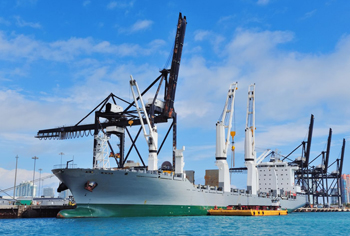
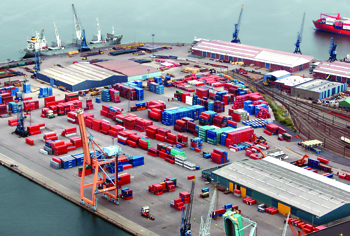
MSc in Marine Engineering and Management
This postgraduate program is designed to cultivate a comprehensive set of knowledge and skills essential in today’s marine engineering field. Graduates are highly soughtafter candidates for employment in ship management and related marine industries, taking on roles such as company superintendents, surveyors, professionals in insurance, and shipbrokers. Furthermore, their expertise is in demand across various sectors beyond shipping, including opportunities in power stations, hospital engineering, and production line engineering.
MSc in Manufacturing Engineering Design
This postgraduate program will broaden, strengthen and integrate knowledge and understanding regarding advanced engineering industry processes. This will include all the necessary academic tools, computational modelling techniques, design, and engineering practice to solve mechanical engineering problems of varying complexity, taking into consideration the economic, social and environmental context.
PhD in Mechanical Engineering
This doctoral program aims to develop experts in Mechanical Engineering, equipping them with the essential knowledge, skills, experience, and ethos to contribute to the advancement of research in their specific field. PhD students, under the guidance of their academic supervisors, are expected to become productive members of the research community, expanding the current understanding in their area of interest and contributing to the broader educational landscape.