
 Search



Frederick University in the Global Dialogue on Sustainable Development


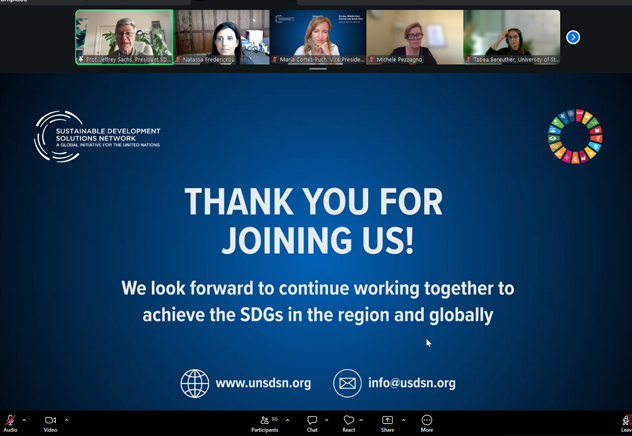
The President of the Council of Frederick University and Co-Chair of SDSN Cyprus, Ms Natassa Frederickou, participated in the 4th international online University Presidents Meeting (UPM) of the United Nations Sustainable Development Solutions Network (SDSN).
The Sustainable Development Solutions Network (SDSN) is a global network of universities, research centers and other knowledge institutions that seeks to harness scientific knowledge and collaboration to advance sustainable development and achieve the Sustainable Development Goals (SDGs).
The meeting brought together representatives from more than 170 universities and organizations across Europe, the Middle East, Central Asia and South Asia. Participants included university presidents, rectors and other senior university leaders, as well as representatives of governments, the United Nations and SDSN leadership.
The discussions focused on the evolving role of higher education in advancing sustainable development. Particular emphasis was placed on regional cooperation, strengthening the links between scientific knowledge and policymaking, and exploring the opportunities that new technologies offer for education, research and innovation. Participants also discussed how universities can help accelerate progress towards the Sustainable Development Goals and shape the post-2030 development agenda.
The meeting opened with remarks by Professor Jeffrey Sachs, President of the UN Sustainable Development Solutions Network (SDSN), followed by contributions from distinguished representatives of academia, international organizations and governments.
In her intervention, Ms Frederickou focused on a central question: what should the role of the university be in a world changing at an unprecedented pace?
She referred to the recently published Sustainable Development Report 2026 – From Goals to Means: The Path to SDG Implementation, highlighting that, as we approach 2030, the challenge is no longer simply to agree on the goals we want to achieve, but to ensure that we have the means, as well as the human and institutional capacity, to put them into practice.
“Universities should not see themselves merely as institutions that produce knowledge for sustainable development, but as active agents of sustainable transformation,” she stated.
She also highlighted the challenges that Artificial Intelligence (AI) poses for education. While acknowledging its immense potential, she raised the question of whether AI's growing ability to perform cognitive tasks could affect the learning process itself. “If AI can take over a large part of the cognitive tasks our students are expected to perform, how do we ensure that they continue to develop the ability to think for themselves?”
In this context, she presented Frederick University's 3Hs philosophy – Head, Heart and Hands – which connects knowledge and critical thinking with empathy, social responsibility and the ability to apply knowledge in practice. She also referred to the Frederick University Living Lab (FULL), through which students collaborate with communities and organizations to address real-world social and environmental challenges.
Ms Frederickou also addressed how universities understand and assess the impact of research. Referring to the growing pressure to publish, generate citations and achieve high positions in international rankings, she stressed that, alongside research excellence, universities must consider whether the knowledge they produce reaches society, influences policies and practices, and contributes to solving real-world problems. “We must be careful not to confuse what we can easily measure with what truly matters,” she noted.
In her concluding remarks, the President of the Council of Frederick University returned to the central message of From Goals to Means, emphasizing that if universities are part of the means through which the SDGs can be achieved, they must rethink how they educate, produce and apply knowledge, and collaborate with society. “Perhaps the question we need to ask today is not simply how universities will adapt to this new world, but what kind of universities this new world needs us to become.”
As she noted, the contribution of universities to the 2030 Agenda will ultimately be measured by the difference they make through their research, their collaborations and, above all, the people they educate.
 View all articles