
 Search



Frederick University and RIT Dubai Deepen Energy Transition Partnership through Erasmus+ Staff Mobility


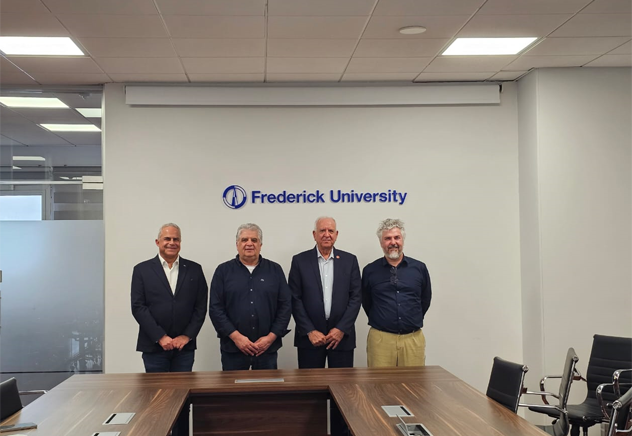
Frederick University and Rochester Institute of Technology of Dubai (RIT Dubai) have further strengthened their strategic collaboration in sustainable energy research and education through an Erasmus+ staff mobility visit to Frederick University and joint participation in MedPower 2026.
From 1-7 November 2026, Prof. Ghalib Kahwaji, Director of RIT Dubai's Sustainability and Energy Center, visited Frederick University's School of Engineering, hosted by the Vice-Rector for Development, Internationalization and Partnerships, Prof. Andreas Poullikkas. The visit followed Prof. Poullikkas's visit to RIT Dubai in February 2026 and advanced the institutions' joint priorities in energy systems innovation, renewable energy, hydrogen technologies and smart grids.
Discussions addressed renewable and sustainable energy systems, hydrogen and fuel cell technologies, smart energy networks and grid modernization, the power-transportation and power-water nexus, carbon capture, storage and use and energy policy and economics. The partners also reviewed the Cyprus energy sector and discussed further staff and student mobility, research internships and hybrid teaching models in energy systems engineering.
"This visit consolidates the partnership between Frederick University and RIT Dubai and takes our collaboration from planning to concrete outputs, including joint research, student mobility and conference dissemination," said Prof. Andreas Poullikkas.
"RIT Dubai values this deepening collaboration with Frederick University. It strengthens our research network, creates mobility opportunities for our students and faculty, and supports our work on smart energy systems and the energy transition," said Prof. Ghalib Kahwaji.
Prof. Kahwaji met with the University Vice President, Dr. Charalambous, and the Rector, Prof. Demosthenous, to discuss possibilities for further collaboration between the two institutions, including joint research, student and academic mobility and the development of joint initiatives.
As part of the visit, Prof. Kahwaji was an invited keynote speaker at the 15th Mediterranean Conference on Power Generation, Transmission, Distribution and Energy Conversion (MedPower 2026). His keynote speech, "UAE energy transition towards smart energy systems", presented the UAE experience in the transition towards smart energy systems to Mediterranean researchers and power-sector professionals and acknowledged the Erasmus+ KA171 support.
The two institutions also presented a joint work at MedPower 2026, entitled "Green Hydrogen Cost Variability under Renewable Intermittency and Electricity Price Uncertainty", by Theodoros Leontiou, Ghalib Y. Kahwaji and Andreas Poullikkas. The paper develops a techno-economic optimization framework for a green hydrogen system supplied by photovoltaics, wind, battery storage and grid electricity. Prof. Kahwaji, also, met with Arfan Jawish, RIT Dubai student who is spending the semester on Frederick University campus as an exchange student supported by the Erasmus+ KA171 collaboration and discussed his courses and research progress.
Building on the visit and the discussions with the leadership of Frederick University, the two institutions will pursue co-authored peer-reviewed journal publications, further joint conference papers and jointly developed research proposals targeting European and international funding schemes. They will also plan a joint Energy Transition Workshop at RIT Dubai, bringing together faculty and graduate students to explore research synergies, funding opportunities and publication targets.
This mobility contributes to Frederick University’s strategy to expand its international research networks in energy engineering and sustainability, while supporting RIT Dubai’s engagement with European research frameworks and funding opportunities. The activity forms part of a three‑year Erasmus+ project coordinated by Frederick University, promoting student and staff mobility with partner institutions across the Middle East, Latin America, and North America.
The mobility was co‑funded by the Erasmus+ Program of the European Union under Key Action 1: Mobility of Higher Education Students and Staff, supported by External Policy Funds.
 View all articles
