
 Search



Joining forces with community Care Home to raise awareness of Alzheimer’s disease


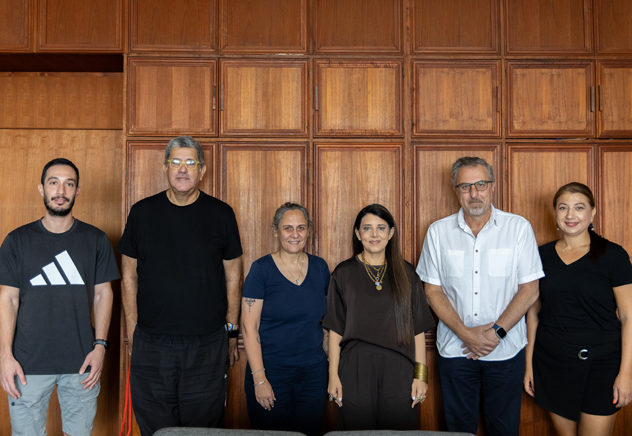
We are joining forces with the Archangel Michael Care Home in Kaimakli to develop and implement a new awareness campaign on Alzheimer’s disease, as part of the pedagogical initiative Frederick University Living Lab (FULL).
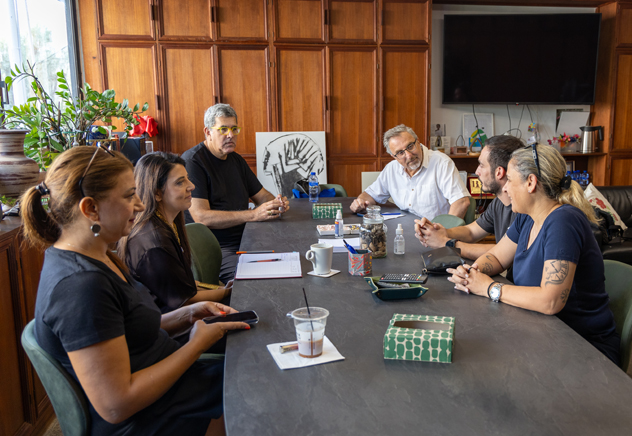
During a meeting held at Frederick University, representatives of the two organisations discussed the next steps for the campaign, which aims to strengthen understanding of Alzheimer’s disease and, above all, highlight the person behind the diagnosis. The initiative brings together two different academic fields at Frederick University, Social Work and Arts and Communication, and a community organisation with direct knowledge and experience in the field of dementia.
The meeting was attended by the President of the Council of Frederick University, Ms Natassa Frederickou; Associate Professor in the Department of Arts and Communication, Dr Dimitris Kokkinolambos; Lecturer in the Department of Psychology and Social Sciences, Dr Koula Erotokritou; Professor in the Department of Arts and Communication, Costas Mantzalos; and the Director of the Archangel Michael Care Home, Ms Ersi Papayianni, accompanied by Assistant Director Mr Thanos Karayiannis.
Students from the Department of Social Work and the Department of Arts and Communication will participate in the project as part of their courses. Working together with the Archangel Michael Care Home, and through direct engagement with people living with Alzheimer’s disease, their families and caregivers, they will have the opportunity to gain a deeper understanding of their everyday lives, experiences and needs.
Interdisciplinarity lies at the heart of the project. Students from the two academic fields will jointly approach a real social issue, bringing together the knowledge, perspectives and tools developed through their studies. They will exchange perspectives and learn with and from one another, connecting the social dimensions of dementia with art, creativity and communication.
This shared learning experience will inform the creative process. Students from the Department of Arts and Communication will develop the visual and communication outputs of the campaign, transforming the knowledge, experiences and insights gained through the collaboration into creative work. These will include an Alzheimer’s symbol, a series of posters, infographics and other communication materials to be used as part of the campaign.
The aim is for the campaign to emerge not simply as an academic exercise or a conventional communication initiative, but from knowledge, collaboration and meaningful engagement with the people whose lives it seeks to address.
“This initiative puts into practice the philosophy of the Frederick University Living Lab (FULL) initiative: creating learning opportunities that go beyond the classroom and connect our students with real needs within society,” said Ms Natassa Frederickou. “The interdisciplinary dimension of the project is particularly important. Students from Social Work and Arts and Communication will approach a complex social issue together, bringing different knowledge and perspectives to the process while learning from one another. And they will do so in collaboration with the Archangel Michael Care Home in Kaimakli, an organisation with knowledge and experience in the field. This is precisely the kind of learning we seek to cultivate: experiential, interdisciplinary, connected to society, and with meaningful impact.”
“This initiative reminds us that behind every diagnosis there is a person,” added Ms Ersi Papayianni. “Real change begins when we stop defining people by what they are losing and start recognising them through everything that remains: their presence, relationships, history, emotions and dignity. A society truly changes when a person ceases to be seen as a ‘case’ or a ‘diagnosis’ and is once again recognised as a person.”
The initiative is being developed as part of the Frederick University Living Lab (FULL), a pedagogical initiative of Frederick University that connects learning with real needs and challenges within society. Through FULL, students from different academic fields collaborate with one another and with community organisations, applying their knowledge in practice, learning beyond the boundaries of their own disciplines, and co-creating projects with real social impact.
This collaboration embodies precisely this philosophy: different academic disciplines, a community partner and a real social need come together in a shared space for learning and creation.
 View all articles